ultimate-guide
How to Build an HOA Emergency Preparedness Plan Checklist
Last Updated: October 28, 2026
Quick Summary
A hoa emergency preparedness plan checklist is a written, board-approved document that assigns every preparedness task to a named person, sets a deadline, and records whether the work is done. A complete checklist covers eight areas, from hazard and risk assessment to plan testing through drills and reviews.
- Give every checklist line a named owner, a due date, and a status of Not Started, In Progress, or Complete.
- Recruit five to seven residents with skills the association needs and name an alternate for every role.
- Score each hazard from 1 to 5 on likelihood and consequence; anything scoring 12 or above gets a dedicated playbook.
- Use at least three notification channels and assume any one will fail during an emergency.
- Audit the 72-hour kit twice a year, replacing expired items and testing generators under load.
Table of Contents
- What an HOA Emergency Preparedness Plan Checklist Must Cover
- Forming an Emergency Preparedness Committee and Defining Roles
- Running a Hazard and Risk Assessment for Your Community
- Building an HOA Emergency Communication Plan
- Evacuation Routes, Assembly Points, and Shelter-in-Place Procedures
- Your HOA Emergency Supplies List and 72-Hour Kit
- The HOA Hurricane Preparedness Checklist for South Florida
- Adapting Your Multifamily Disaster Preparedness Plan for Accessibility and Vulnerable Residents
- Frequently Asked Questions
What an HOA Emergency Preparedness Plan Checklist Must Cover
A hoa emergency preparedness plan checklist is a written, board-approved document that assigns every preparedness task to a named person, sets a deadline, and records whether the work is done. A checklist can be used as the plan itself, not just an appendix to it.
The Eight Sections Every Plan Needs
A complete checklist can cover eight areas: hazard and risk assessment, committee structure and roles, the resident roster and emergency contact list, notification and communication channels, evacuation routes and shelter-in-place procedures, supplies and the 72-hour kit, recovery and business continuity, and plan testing through drills and reviews.
State law and your governing documents set the floor for what an association must do. Florida Division of Condominiums, Timeshares, and Mobile Homes publishes the statutory requirements for official records and board obligations that shape how you store and share the plan.
Assigning Owners, Deadlines, and Status Fields
A checklist without owners is a wish list. Give every line three fields: a named owner, a due date, and a status of Not Started, In Progress, or Complete. Review status at each board meeting and record the review in the minutes.
Boards that would rather hand off the coordination can see the full range of management services that take on these tasks across Palm Beach and surrounding communities.
Forming an Emergency Preparedness Committee and Defining Roles
The committee is the engine of the plan, but a committee without written authority is just a discussion group. The board should adopt a one- to two-page charter that names each role, states what that role may decide without a board vote, and sets a reporting cadence. Review the charter annually alongside the master checklist.
Committee Size and Composition
Recruit five to seven residents with skills the association needs: a retired contractor or building engineer for facilities, a nurse or EMT for medical triage, a communications professional for resident messaging, someone comfortable with spreadsheets and alert platforms for the roster, and at least one on-site resident who can inspect damage. Avoid stacking the committee with board members only, you want redundancy if a board member is unavailable.
Roles, Authority, and Decision Boundaries
Write each role with three fields: responsibilities, spending authority, and escalation trigger. A common pattern gives the chair authority to authorize emergency spending up to a set dollar threshold without a board vote, with anything above requiring a phone or email board vote. Set the threshold in the charter, not in a hallway conversation.
- Chair: runs meetings, owns the master checklist, reports to the board at every regular meeting, and is the single point of contact for the management company. Authority: convene the committee, activate the plan, authorize spending up to the charter threshold.
- Vice chair / succession: assumes the chair's duties if the chair is unreachable for a set period (commonly 12-24 hours during an activation). Name this person in the charter.
- Communications lead: maintains the resident roster and alert platform, drafts and sends notifications, and keeps the message templates current. Authority: send pre-approved message templates without board review; route new messaging through the chair.
Board Oversight and Records
The board remains accountable for the plan even when it delegates execution. Adopt a resolution that approves the charter, names the committee members and alternates, and sets the reporting cadence, monthly during hurricane season or any active threat, quarterly otherwise. Record committee reports in the board minutes, and keep the charter, current roster, and activation log in the association's official records for inspection under the governing documents and applicable state law.
Succession and Redundancy
Every role needs a named alternate, and every critical document needs two custodians who do not share a login. A simple pattern: the chair and vice chair each hold a sealed paper binder with the roster, site plan, vendor list, and shutoff map; the communications lead and community manager each hold backup access to the alert platform. Test succession yearly by having the alternate run a meeting and send a test notification.
Boards still deciding whether to outsource coordination can request management proposals and compare how providers handle emergency roles, activation authority, and after-hours coverage.
Running a Hazard and Risk Assessment for Your Community
Start with the hazards that actually threaten your property, then rate each by likelihood and consequence. A barrier-island high-rise faces a different profile than an inland 80-unit community, and a wood-frame townhome cluster faces a different wildfire profile than a concrete mid-rise. The assessment's only job is to tell you which playbooks to write and which checklist lines to prioritize.
Building the Hazard Matrix
List every hazard with a realistic chance of affecting the community within ten years: hurricane and tropical storm, flooding (storm surge, flash flood, riverine), severe thunderstorm and tornado, wildfire and smoke, earthquake (where applicable), winter storm and freeze, extended power outage, water main break, and hazardous materials release from a nearby roadway or rail line.
Score each hazard from 1 to 5 on two axes:
- Likelihood: 1 = rare, 5 = expected within the planning horizon
- Consequence: 1 = inconvenience, 5 = threat to life, major structural damage, or prolonged displacement
Multiply the two numbers. Anything scoring 12 or above gets a dedicated one-page playbook and a named owner on the master checklist; 6 to 11 gets a short procedure embedded in the general plan; 5 or below gets a monitoring note only. Record the assessment date and the names of the people who scored it, it is a board record, not a working draft.
Writing Incident-Specific Playbooks
A playbook is one page, and it answers four questions: what triggers activation, what the first three actions are, who calls them, and who is notified. Keep the trigger concrete. "Hurricane watch issued for the county" is a trigger; "weather looks bad" is not.
- Hurricane or tropical storm: trigger is a watch or warning issued for the county. First three actions: facilities lead tests generators and confirms fuel; communications lead pushes the pre-approved storm notice; staff secure loose furniture, pool equipment, and trash bins. Owner: chair.
- Flood (flash or storm surge): trigger is a flood watch, a surge warning, or water observed in a known low area. First three actions: move vehicles and equipment to higher ground; confirm the secondary assembly point is accessible; notify residents on the ground floor or in the flood zone. Owner: facilities lead.
- Wildfire or smoke event: trigger is an evacuation warning, a red flag warning with nearby fire activity, or visible smoke. First three actions: confirm the evacuation route and assembly point are clear; push the air-quality and evacuation notice; check the accessibility registry for residents who need transport. Owner: liaison.
Connecting the Assessment to the Checklist
Every playbook produces checklist lines. A hurricane playbook generates lines for generator testing, fuel contracts, shutter inventory, and notification templates; a flood playbook generates lines for sandbag stock, sump pump checks, and ground-floor resident outreach. Assign each line an owner, due date, and status field, and review status at every board meeting. The assessment is only useful if it changes what is on the checklist and who is responsible.
Reviewing and Updating
Re-score the matrix annually, and re-score it immediately after any near-miss, actual event, or major change to the property (new construction, a change in flood zone designation, a new hazardous materials route nearby). The National Weather Service hurricane preparedness guidance is a practical starting point for severe weather and flood risk, and your county emergency management office publishes local hazard mitigation and evacuation information that should inform the likelihood scores.
Building an HOA Emergency Communication Plan
An HOA emergency communication plan is the documented set of channels, contacts, and message templates the association uses to reach every resident before, during, and after an emergency. It fails most often for one reason: the roster is out of date.
Resident Notification Channels and Backup Access
Use at least three channels and assume any one will fail. Email, text alerts, a phone tree, the community website, and printed notices at building entrances form a sensible stack. Keep a paper copy of the roster in a sealed binder held by two different board members.
Keep backup access with at least two people who do not share a login.
Evacuation Routes, Assembly Points, and Shelter-in-Place Procedures
Evacuation planning starts with a site plan. Mark every exit, stairwell, elevator bank, and utility shutoff valve, then post printed copies at each building entrance and in common areas.
Shelter-in-place procedures matter just as much, particularly for high-rises. Decide in advance who orders residents to stay put, how that order is communicated, and what happens to elevators during a power outage.
Your HOA Emergency Supplies List and 72-Hour Kit
Stock supplies for the community, not just individual households. A workable HOA emergency supplies list covers water, nonperishable food, flashlights, batteries, a weather radio, first aid kits, tarps, plywood, sandbags, generators, fuel, and debris-clearing tools.
Build a 72-hour kit sized for your common areas and staff, and audit it twice a year. Replace expired items, test generators under load, and log every check.
The HOA Hurricane Preparedness Checklist for South Florida
An HOA hurricane preparedness checklist can follow a countdown. At 72 hours out, the facilities lead tests generators and confirms fuel, the communications lead pushes a storm notice, and staff secure loose furniture and pool equipment.
After landfall, the first task is a damage assessment walk with photographs, followed by debris staging in a pre-marked area and a resident notification. Boards that want local support executing the plan can review HOA management support for Palm Beach communities.
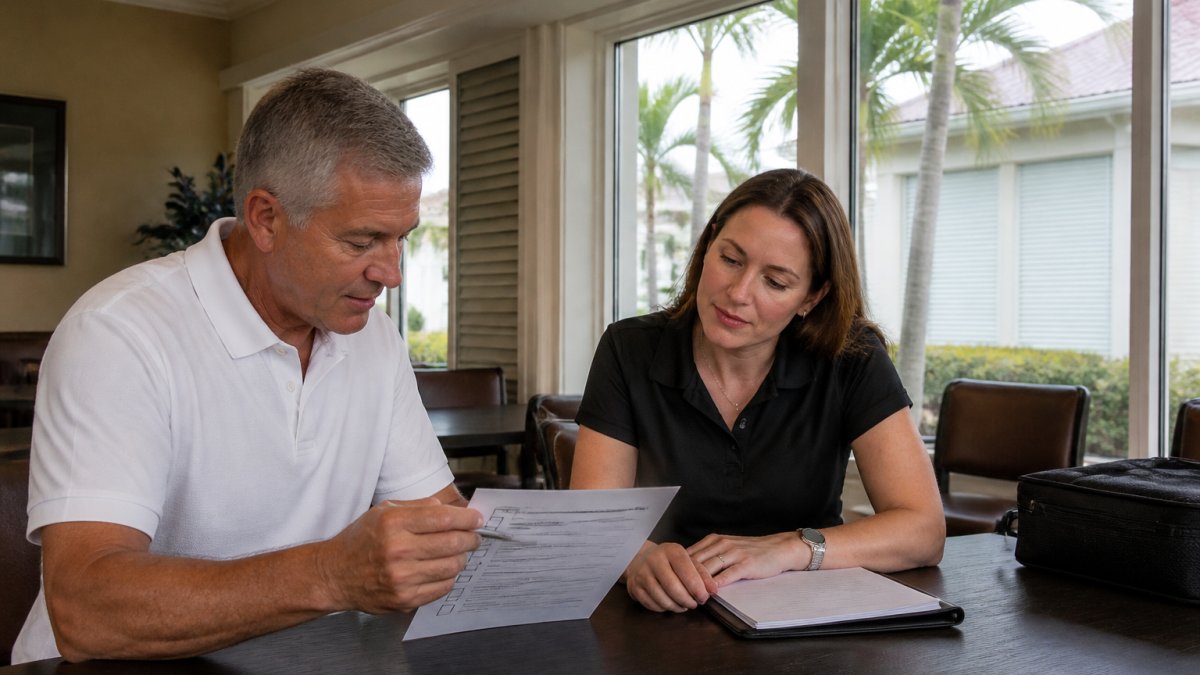
The hurricane checklist follows a countdown from 72 hours out through the walk after landfall.
| Timing | What to do | Who |
|---|---|---|
| 72 hours out | Test generators and confirm fuel | Facilities lead |
| 72 hours out | Push the storm notice | Communications lead |
| 72 hours out | Secure loose furniture and pool equipment | Staff |
| 24 hours out | Put shutters up | Not stated |
| 24 hours out | Park elevators at an upper floor | Not stated |
| 24 hours out | Confirm the roster | Not stated |
| After landfall | Damage assessment walk with photographs | Not stated |
| After landfall | Debris staging in a pre-marked area and resident notification | Not stated |
Adapting Your Multifamily Disaster Preparedness Plan for Accessibility and Vulnerable Residents
A multifamily disaster preparedness plan must account for residents who cannot self-evacuate. Build a voluntary, confidential registry of residents who need assistance, and pair each person with a named neighbor or staff member. Never publish the list.
- Confirm accessible evacuation routes and identify residents who use mobility devices
- Translate key notices into the languages spoken in your community
- Check on older adults by phone or door knock during and after an event
Plan for recovery too. For board resources on governance topics like this, Harshman Community Management publishes practical guides for local boards.
Frequently Asked Questions
What should an HOA emergency preparedness plan include?
A complete HOA emergency plan includes a hazard and risk assessment, a named emergency preparedness committee with defined roles and decision-making authority, an updated resident roster and emergency contact list, evacuation routes and assembly points, shelter-in-place procedures, a resident notification system, an emergency supplies list, and a plan for damage assessment and recovery. Each item needs a named owner, a deadline, and a status field so the board can track what is done and what is still outstanding. Review the whole document at least once a year and after every drill.
Who is responsible for emergency preparedness in an HOA?
The board holds overall responsibility, but day-to-day execution belongs to an emergency preparedness committee that reports to the board. That committee typically includes a chair, a communications lead, a supplies and facilities lead, and a liaison to local emergency services. The board approves the plan, funds supplies, and sets the review schedule. The board remains accountable for the plan being current and usable.
How should an HOA communicate with residents during an emergency?
Use at least two channels so a single failure does not cut off contact. A mass notification system handles texts, emails, and calls, while a printed phone tree and a community bulletin board cover residents without smartphones. Store the HOA emergency communication plan offline and in the cloud so it stays reachable during a power outage. Send a short pre-season message explaining how alerts will arrive, then test the system twice a year. During an event, send brief updates on a fixed schedule so residents know when the next information is coming.
What emergency supplies should an HOA keep on hand?
An HOA emergency supplies list should cover the common areas, not individual units. Stock water and nonperishable food for 72 hours, flashlights, batteries, a battery-powered radio, first aid kits, fire extinguishers, tarps, plywood, sandbags, work gloves, and basic tools. Include a generator or backup power for clubhouse lighting and phone charging, plus a printed copy of the resident roster and building site plan. Check expiration dates each quarter and log the inspection so the board has a record.
How can an HOA prepare for hurricanes, flooding, and power outages?
Start with the HOA hurricane preparedness checklist: trim trees before storm season, confirm shutters and impact glass are in place, clear drains and swales, test the generator, and document the condition of roofs and common areas with dated photos. Identify utility shutoff valves and building access points on a site plan. For flooding, stage sandbags and know which units sit in low-lying areas. For outages, keep backup lighting, a charging station, and a printed contact list. Run one drill before June 1 so residents know where to go.
What are the 5 P's of disaster preparedness?
The 5 P's are plan, prepare, protect, practice, and partner. An HOA plans by writing the emergency preparedness plan and assigning owners. It prepares by stocking supplies and updating contact lists. It protects by securing buildings, documenting conditions, and confirming insurance coverage. It practices through drills and tabletop exercises. It partners with local emergency services, first responders, and a managing agent who knows the community. Boards that treat all five as ongoing tasks rather than a one-time project stay ready between seasons.
Emergency planning exposes every gap in a community's operations, usually at the worst possible moment. Harshman Community Management builds and maintains preparedness checklists for HOAs, condominiums, and high-rises across Palm Beach and South Florida, with onsite, portfolio, and Virtual CAM service models that put a named owner behind every task. Get started with Harshman Community Management and turn your checklist into a plan your board can actually execute.
